Custom Aluminum Tin Can Programs: An OEM Capability Guide for Buyers
If you have reached the point of evaluating aluminum can suppliers, you already know the material works for your product. The question now is narrower and harder: can this specific factory produce your can — at your volume, with your artwork, to your food-contact standard, and on a schedule your launch plan can absorb?
Creative Package operates a metal packaging line out of Hefei, Anhui Province, as part of a group that also runs glass and plastic production. Our aluminum can capability covers OEM and ODM production, with eight customization areas: size, capacity, coating, printing, color, logo, graphic and packaging. We hold ISO 9001, FDA and CE certification, and our cans ship to more than 150 countries and regions.
One note on terminology: buyers often search using "tin can" when they mean aluminum can. This guide refers to aluminum cans throughout. If you are comparing aluminum with tinplate, the base material, coating system and inspection requirements are different — confirm which one you are quoting against.
The Sourcing Problem: A Catalogue Photo Is Not a Specification
Beverage brands come to us with a range of search terms — soda can, beer can, coffee can, energy drink can, 3.5 soda can. These are all aluminum cans, but they are not the same project. Each one implies a different fill volume, a different closure, a different barrier requirement and a different decoration density. A supplier that produces a clean 330ml soda can at high speed may not be set up for a short-run coffee can with a recloseable lid.
The risk for buyers is that a vague inquiry produces a vague quote, and a vague quote is impossible to compare with another supplier's vague quote. What you need from a factory at the RFQ stage is a concrete answer to four questions:
- Which can diameters, heights and volumes can your tooling actually produce?
- Which decoration methods (offset printing, silk screen, color coating) run in-house versus subcontracted?
- What internal coating options do you offer, and what food-contact evidence comes with them?
- At what volume does your pricing structure start, and how does lead time scale?
A factory that can answer those in writing is one you can build a specification with. A factory that answers with a catalogue link is not there yet.
What We Build Into a Custom Aluminum Can
Our metal packaging operation runs at a monthly capacity of 300 million pieces. The MOQ for custom production is 100,000 pieces. Lead time scales with volume: small runs up to 10,000 pieces ship in about 7 days, mid-range orders up to 500,000 pieces take roughly 15 days, and anything above that is negotiated per order based on tooling and decoration complexity.
Commercial terms are straightforward: FOB, CIF and EXW are all available. Payment is 30% T/T deposit before production starts, with the remaining 70% due against a copy of the bill of lading. Pre-shipment inspection is included in every order, and after-sales technical support is handled remotely. Our operation employs 250 people including a 15-person engineering team, with reported annual output of CNY 180 million.
Eight Customization Areas and What Each One Decides
When a buyer sends us a brief, we work through eight customization areas in sequence. The order matters because each one constrains the next:
- Size — Determines the fill volume and which filling/seaming line the can will run on
- Capacity — Confirms the actual liquid volume the can holds, which may differ from the nominal size
- Coating — Sets the internal lining specification: BPA-free, adhesion grade, and compatibility with the specific beverage
- Printing — Chooses the decoration method and defines how many colors, which finish, and what registration tolerance is acceptable
- Color — Locks the Pantone targets so repeat orders stay consistent
- Logo — Determines how the brand mark is applied and how it is verified on the line
- Graphic — Manages the artwork system across multiple SKUs so a brand family looks coherent on shelf
- Packaging — Sets the carton, divider and pallet configuration that gets the cans to the destination intact
The coating and closure decisions are where most programs generate hidden cost. A buyer who specifies a standard easy-open end and later switches to a recloseable lid has changed the tooling, the torque specification and the airtightness test method — effectively starting a new quotation.
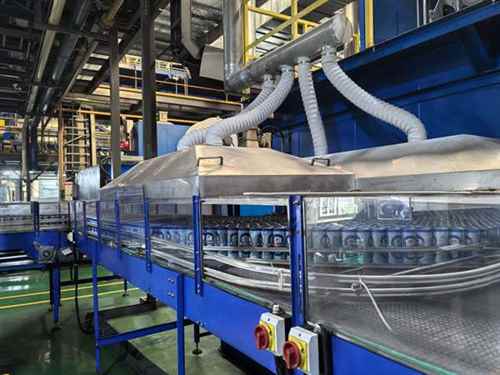
How the Can Is Made: A Walk Through the Production Line
Understanding the production sequence helps buyers know where to push for process control and where to accept the factory's standard.
Step 1 — Coil to cup. Production starts with aluminum coil. The coil is fed into a stamping press that cuts and draws it into a shallow cup. The cup is then deep-drawn through successive dies until it reaches the final can body dimensions. At this stage, wall thickness, height and mouth diameter are set. A can that drifts outside tolerance here will not seam correctly on the buyer's filling line — and the problem will not surface until the buyer's factory, where it becomes expensive.
Step 2 — Cleaning and internal coating. The drawn can body is washed to remove forming lubricants and prepare the surface. The internal coating is then sprayed and cured. This is the food-contact barrier — the layer that stands between the beverage and the aluminum wall. Our lining is specified as BPA-free, and every incoming coating batch is checked against a Certificate of Analysis before it enters production. We also keep batch retention samples so that if a quality issue surfaces after shipment, the original material can be traced and tested.
Step 3 — Base coat, printing and overvarnish. The external decoration system starts with a white base coat, followed by the printed artwork (offset lithography for most beverage cans), and finished with a protective overvarnish. Color consistency across a run depends on ink formulation, plate condition and drying temperature. Our line includes a logo inspection and verification station that scans every can for registration accuracy and artwork completeness — this is a control point buyers should specifically ask about, because not every supplier has one.
Step 4 — Curing, necking and inspection. After printing, the cans pass through a curing oven to fully set the ink and varnish. The neck is then formed (for beverage cans that use an easy-open end), and the finished can enters end-of-line inspection. Here we run dimensional checks, visual defect screening and a 100% airtightness test on every unit. Where a lid is involved, cap torque is controlled within defined upper and lower limits. Coating adhesion is tested on sampled units from the batch.
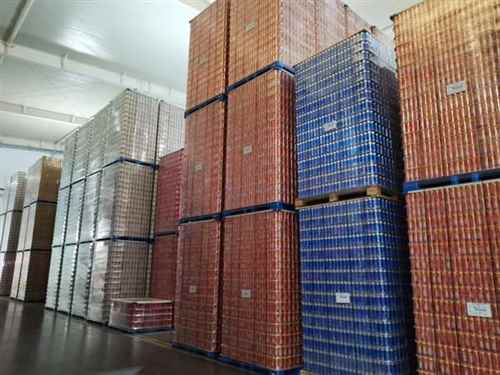
Step 5 — Palletizing. Cans are stacked, palletized and stretch-wrapped for shipment. Drop testing is conducted on packed pallets before dispatch to verify that the transit configuration holds up under handling and container loading.
Food-Contact Evidence: What the Paper Trail Actually Covers
The BPA-free lining declaration is backed by test report ZTS25012103ERC, issued on 12 February 2025 by Shenzhen ZTS Testing Service Co., Ltd. The test scope covers aluminum can coating under four regulatory frameworks: EU Regulation (EC) No 1935/2004 (the general food-contact materials framework), EU Regulation 2018/213 (the specific BPA migration limit), EU Regulation 10/2011 (plastic food-contact materials, referenced for coating components) and CEN/TS 13130-13:2005 (the test method for BPA specific migration).
Here is what that report does and does not mean for a buyer:
It does confirm that the lining material, as tested, meets the referenced BPA migration limits under the stated conditions. It supports the BPA-free declaration at the material level. It gives the buyer a document that can be placed in a compliance file.
It does not prove that the lining will perform identically with every beverage. Hot fill above the coating's rated temperature, prolonged contact with strongly acidic or alcoholic formulations, or extended shelf-life storage can all affect lining performance in ways the material test alone cannot predict. A buyer with an aggressive product profile should run a fill trial — fill the actual beverage into the can, store it under the intended conditions, and re-test. The lab report starts the qualification; the fill trial finishes it.
Where the Format Has Worked: Real Customer Programs
Our aluminum can case record includes five disclosed programs across three beverage categories:
- A US brewery running canned beer, with an annual contract value of USD 1.2 million
- A fruit winery in Great Britain producing canned fruit wine, at USD 800,000 annually
- A fruit winery in Korea producing canned fruit wine, at USD 400,000 annually
- A beverage plant in Kazakhstan running canned beverages, at USD 500,000 annually
- A beverage plant in the UAE running canned beverages, at USD 500,000 annually
Across all five, the feedback pattern is consistent: the cans run stable on high-speed filling and seaming lines, meet food-grade requirements, and deliver reliable seal performance and corrosion resistance against the packed product. Contract durations are not publicly disclosed.
What these cases tell a buyer is where the format has proven itself — beer, fruit wine and standard beverages on automatic filling lines at ambient temperature. What they do not tell a buyer is that any beverage will work. A coffee can program, for instance, typically involves a different closure (recloseable lid rather than easy-open end), a higher oxygen barrier requirement and a different filling temperature profile. If you are sourcing a coffee can, treat it as a separate specification from the start.
Aluminum, Glass or Plastic: Choosing With Your Eyes Open
Material selection is not about which is "best" — it is about which matches the product, the filling process and the order pattern.
Aluminum wins when the buyer needs lightweight, breakage-resistant packaging that runs at high speed on automated filling and seaming lines, with strong barrier properties and a premium printed surface. The trade-off is volume commitment: at a 100,000-piece MOQ, aluminum is not a low-volume trial material. Decoration setup (plates, color matching, drying trials) is a fixed cost that does not shrink with a smaller order. And a standard beverage can is not resealable — if the product needs recloseability, that is a separate closure specification.
Glass wins where resealability, premium shelf presence and product visibility matter — honey, jam, sauces, spirits. Glass is heavier and more breakable, and it typically runs at lower line speeds, but it carries a different consumer perception. (We cover glass jar sourcing separately in our glass jar guides.)
Rigid plastic wins where tooling cost needs to stay low, where squeezability is a functional requirement, or where the product format does not justify the volume commitment of aluminum. PET bottles and preforms are a strong fit for high-volume bottled water, beverages and personal care.
The practical test is simple: match the material to the fill volume, the closure requirement, the shelf-life target and the order quantity. If any one of those four pulls toward a different material, the others should not override it.
What the Market Is Asking For Now
Two shifts are changing how buyers qualify aluminum can suppliers.
The first is a move from price-first to documentation-first sourcing. Procurement teams are no longer satisfied with a unit price and a "food grade" label. They want to see the BPA-free lining declaration, the COA for the incoming coating batch, the batch retention sample policy, the airtightness test method and the coating adhesion test results. A supplier that can produce those records as part of a standard quotation is easier to put on an approved vendor list than one that scrambles to assemble them after the PO is issued.
The second is format diversification. Beverage brands are launching in smaller, more targeted formats — trial-size soda cans, single-serve coffee cans, limited-edition beer cans — alongside their core high-volume lines. This means a supplier needs to handle custom decoration and short-run formats without disrupting standard production scheduling. Our operation is set up for that: OEM/ODM customization runs alongside a 300-million-piece monthly capacity, so a custom order does not displace a volume order.
FAQ
I need a coffee can with a recloseable lid. How is that different from a standard beverage can?
A standard beverage can uses an easy-open end that is seamed once and cannot be resealed. A coffee can with a recloseable lid needs a different closure system (typically a plastic overcap that threads or snaps onto the can neck), a separate torque specification, and a different airtightness test method. The barrier requirement is also higher because roasted coffee is sensitive to oxygen and moisture. Send us the closure drawing, the target shelf life and the filling method, and we will scope it as a separate specification.
How do you handle artwork approval for a new custom can?
The buyer provides artwork files and Pantone references. We produce a printed sample can for visual verification — color match, registration, logo placement and finish. The buyer inspects the physical sample and either approves or requests adjustments. Mass production only starts after written approval. This process exists because a printed sample costs a fraction of what a full production run costs to correct if the artwork is wrong.
My first order is 30,000 pieces. Can you produce below the 100,000 MOQ?
The 100,000-piece MOQ applies to custom mass-production pricing because tooling, plate setup and line changeover costs are fixed regardless of volume. For a 30,000-piece first order, we can discuss whether a standard format with custom labeling (rather than custom printing) is a more cost-effective entry point. Some buyers launch with a stock can and custom label, then move to full custom printing once volume justifies the setup cost. This is a commercial decision, not a technical limitation.
What happens if coating adhesion fails during an order?
Adhesion is tested on sampled units from each batch. If a batch shows poor adhesion, those units are held and not shipped. The root cause is typically a coating material issue or a curing temperature deviation — both traceable through our batch records and retention samples. If adhesion failure appears after shipment (for example, from impact during transit), the affected cans should not be used for food or beverages. Buyers should report the issue with batch numbers so we can trace the material lot and investigate.
Conclusion
A custom aluminum can program succeeds when four things line up: the can runs on your filling and seaming line, the internal coating is validated for your actual beverage, the decoration meets your brand standard on a physical sample, and the volume and lead time fit your launch schedule. Creative Package can commit to all four with documented evidence — from the BPA test report to the 100% airtightness test on every unit.
The fastest way to move from evaluation to quotation is to send us the product type, fill volume, can format, closure preference, artwork and estimated quantity. We will respond with a configuration and a price.
Next Step: Sample and Quotation
- Website: www.creative-package.com
- Address: Hefei, Anhui Province, China