PET Preform OEM: In-House Mold Engineering for Custom Preforms
A custom PET preform is only as reliable as the mould behind it. When a bottle design moves away from a standard preform, the mould determines whether the finished preform can maintain the required neck dimensions, weight distribution and repeatability during production.
For bottle manufacturers, beverage brands and packaging buyers, this makes mould engineering an important part of PET preform OEM—not simply a tooling step before production.
Why Mold Engineering Matters in PET Preform Production
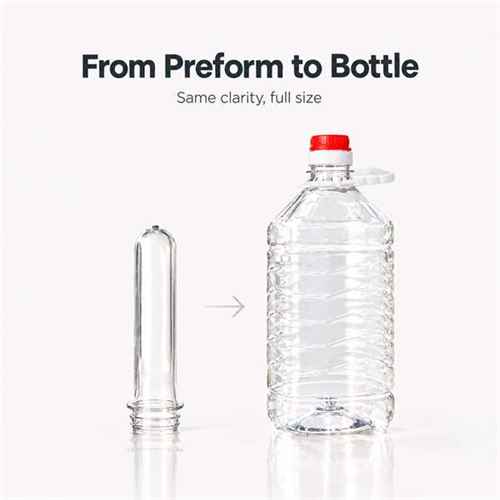
A PET preform is designed to be stretched and blown into a finished bottle. Its dimensions therefore need to work with the final bottle geometry rather than being considered as an isolated plastic part.
A change in bottle design can affect:
- Preform length and overall geometry
- Material distribution during blowing
- Preform weight
- Neck finish and closure fit
- Wall thickness after blowing
- Bottle strength and stability
A mould that is not properly matched to the preform design can create problems that only become visible during blow molding.
This is why custom PET preform development should start with the finished bottle requirements and work backward to the preform and mould.
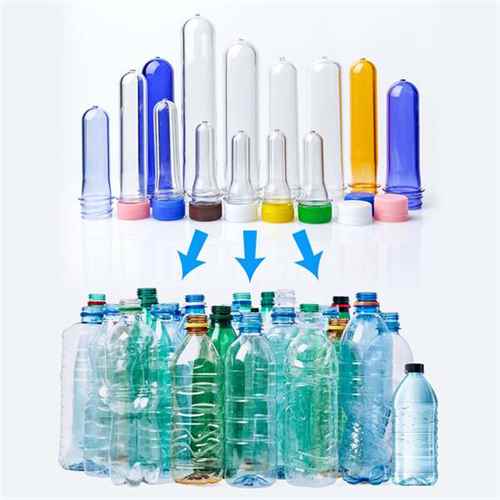
From Bottle Design to Preform Mold
A typical custom PET preform project follows a connected development process:
Bottle Design → Preform Design → Mold Engineering → Trial Production → Blow Test → Final Adjustment → Mass Production
Each stage affects the next.
The bottle shape determines where material needs to be distributed during blowing. The preform design translates these requirements into a suitable starting geometry. The mould then needs to reproduce that geometry consistently across production cycles.
For buyers developing a new bottle, providing the finished bottle drawing or 3D model can make this process much more efficient.
What Can Be Engineered Into a Custom Preform Mold?
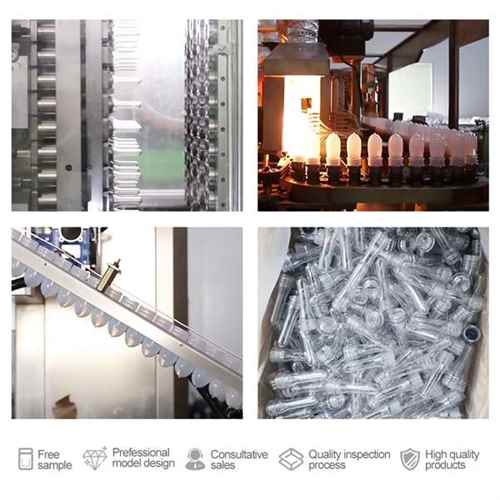
Custom mould development is not limited to changing the external shape of a preform. Several technical details need to work together.
1. Preform Geometry
The preform length, body profile and material distribution need to correspond with the target bottle.
For lightweight bottles, the design needs to place material where it contributes most to the finished bottle's strength. For heavier or wider-mouth bottles, the preform structure may require a different design approach.
2. Neck Finish
The neck is one of the most critical areas because it is not stretched in the same way as the bottle body.
The preform neck must match the intended closure system and filling equipment. A small dimensional deviation can affect cap fit, sealing and capping performance.
For this reason, the neck finish should be fixed before mould development rather than treated as a final adjustment.
3. Preform Weight
Weight affects how much PET material is available during blow molding.
A simple increase in preform weight does not automatically produce a stronger bottle. Material needs to be distributed correctly through the preform so that the finished bottle achieves the required wall thickness and mechanical performance.
The target bottle weight should therefore be considered together with the preform design and mould configuration.
4. Gate and Base Design
The gate area is another important part of mould engineering.
Gate geometry can influence material flow, cooling and the appearance of the finished preform. The base design also affects how material behaves during the blowing process.
For demanding bottle designs, these details should be evaluated during mould trials rather than relying only on the initial CAD design.
Mold Trials Are Part of the Development Process
A mould may look correct on a drawing but still require adjustment after the first trial.
During a preform trial, manufacturers can evaluate:
- Preform dimensions
- Weight consistency
- Neck finish accuracy
- Appearance
- Gate condition
- Material distribution
- Blow molding performance
The preforms should then be tested on the intended bottle blow molding process.
This is particularly important for custom bottle shapes. A preform can meet its dimensional specification but still produce uneven material distribution after blowing.
The real test is whether the preform consistently produces the required bottle.
Designing for Mass Production
A prototype mould and a production-ready mould are not necessarily the same thing.
For commercial production, the mould needs to support repeatable output over a large number of cycles. Cooling, cavity consistency, material flow and dimensional stability all become more important as production volume increases.
This is where mould engineering becomes closely connected with injection molding.
A well-developed preform mould should help maintain consistent:
- Cavity-to-cavity dimensions
- Preform weight
- Neck finish
- Cycle performance
- Cooling behavior
- Finished preform appearance
For buyers, this means evaluating the supplier's tooling and production capabilities together rather than selecting a mould supplier and preform manufacturer separately without technical coordination.
Multi-Cavity Molds and Production Consistency
PET preform production commonly uses multi-cavity moulds for higher output.
The advantage is straightforward: more cavities allow more preforms to be produced during each injection cycle.
The challenge is consistency.
If one cavity produces a slightly different weight or dimension from another, the variation can carry through to the bottle-blowing stage.
For this reason, cavity balance and dimensional control are important considerations when evaluating a high-volume PET preform production program.
When Should a Buyer Request a Custom Mold?
A standard preform is often sufficient when the bottle uses a common neck finish and a proven bottle design.
Custom mould development becomes more relevant when:
- The bottle has a new or unusual shape
- A specific bottle weight is required
- Material distribution needs to be optimized
- A new neck finish is required
- The bottle requires a wider mouth
- Existing standard preforms do not perform well on the blow molding line
- A lightweight bottle needs better strength-to-weight performance
- The buyer is developing a new packaging format
The decision should be based on the finished bottle rather than simply choosing a custom mould because it is available.
PET Preform Mold Engineering for Different Applications
The mould requirements can change depending on the final packaging application.
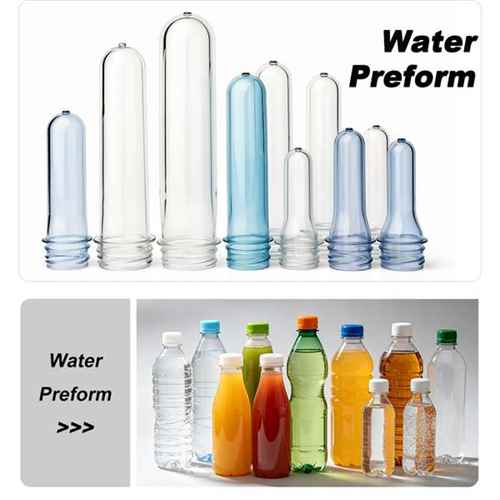
Water bottles often focus on lightweight construction, stable dimensions and efficient material distribution.
Beverage bottles may require stronger bottle performance, especially where carbonation or higher internal pressure is involved.
Edible oil bottles can require different neck and bottle structures depending on the filling system, closure and bottle format.
Wide-mouth food containers usually place greater emphasis on the neck opening, closure compatibility and preform geometry.
Personal care packaging may place more emphasis on appearance, transparency, colour and the relationship between the preform and the final bottle design.
The same PET resin does not mean every preform should use the same mould design.
 |  |  |
|---|
What to Send a PET Preform Manufacturer
A clear technical brief can shorten the development process considerably.
For a custom PET preform project, buyers should provide as much of the following information as available:
- Finished bottle drawing or 3D file
- Target bottle capacity
- Target bottle weight
- Neck finish or closure drawing
- Preform weight target
- Bottle application
- Filling method
- Blow molding equipment
- Required colour
- Expected production volume
If the bottle has already been tested, existing problems should also be included. For example, uneven wall thickness, weak bottle shoulders, unstable bases or inconsistent neck dimensions can provide useful information for preform redesign.
A Practical Approach to PET Preform OEM
The most efficient PET preform OEM projects are not based on mould development alone.
The preform, mould and finished bottle should be treated as one development system.
A practical workflow is:
1. Define the finished bottle
Confirm capacity, shape, weight and application.
2. Confirm the neck and closure
Make sure the preform neck matches the intended cap and filling system.
3. Develop the preform
Determine the required geometry and material distribution.
4. Engineer the mould
Translate the preform design into a production-ready mould structure.
5. Run samples
Check dimensions, weight and appearance.
6. Perform a blow test
Evaluate how the preform performs on the actual bottle-making process.
7. Adjust the design if necessary
Correct material distribution or dimensional issues before mass production.
8. Release the mould for production
Once the preform and bottle performance are confirmed, move into regular injection molding.
This approach reduces the risk of discovering a design problem after a large production run has already started.
PET Preform OEM for Custom Bottle Development
For packaging buyers, the value of PET preform OEM is not simply the ability to order a different size or colour.
The more important capability is the ability to connect bottle design, preform design, mould engineering and injection production into one process.
When a new bottle requires a custom preform, the mould should be developed around the actual bottle requirements. Proper tooling can improve dimensional consistency, material distribution and production repeatability while reducing unnecessary adjustments during blow molding.
For Creative Package, custom PET preform development can be approached as part of the wider packaging development process—from the required bottle format through to the preform and production stage.
Conclusion
Custom PET preform projects work best when mould engineering starts with the finished bottle rather than with a standard preform catalogue.
Bottle geometry, neck finish, preform weight, material distribution and blow molding conditions all influence the mould design. Trial production and blow testing then provide the feedback needed before the mould enters regular production.
For buyers developing a new PET bottle, the key question is therefore not only “Can the supplier make a custom preform?” but also “Can the supplier engineer the mould around the bottle I need to produce?”
That distinction can make a significant difference to the stability and efficiency of the final PET packaging project.